Going to a surf camp alone: what to expect if it’s your first time
Going to a surf camp alone is one of those ideas that feels both exciting and a little intimidating at the same time. We get asked about it all the time: “Will it be weird?”, “What if everyone else comes in a group?”, “Will I fit in?”. And honestly, it’s a completely normal thing to wonder about.
A lot of people think about travelling on their own, especially if it’s their first time. What really matters is not so much whether you come with someone or not, but choosing the kind of experience where you can feel comfortable, in an environment that suits you, and without any pressure from the very beginning.
By the end of this article, you’ll see that coming to a surf camp on your own is actually very common, mainly because of the kind of setting and experience you’ll find there.
Does it make sense to do it this way?
Yes, for a lot of people it makes perfect sense. You don’t need to come with someone to enjoy the experience. Sometimes, it even works better that way.
You arrive with a clearer head, without having to coordinate plans with anyone else, and with more room to live each day your own way.
What matters is not whether you come alone, but whether the place and the format suit you. Because when you choose the right kind of atmosphere, going to a surf camp alone stops feeling like a strange idea and starts to feel completely natural.
What usually worries people most at the beginning
The same doubts tend to come up almost every time.
The first is not knowing anyone. Then comes the feeling that maybe everyone else will arrive with friends, as a couple, or as part of an already established group.
There’s also often the fear of feeling out of place, of not connecting with the atmosphere, or of thinking you need a certain level to fit in.
On top of that, there are other concerns that are less obvious, but just as real: not knowing how you’ll handle the quieter moments, wondering whether a shared room will feel comfortable, or worrying that there might be too much social interaction for what you actually need.
What to look at to know whether you’ll feel comfortable
This is where it’s worth paying close attention. First of all, the accommodation. Sleeping in a shared room, having to sort everything out yourself by renting a place separately, or having a private room are all very different experiences, and none is better by default.
It depends on how you like to rest, how much privacy you need, and how you relate to others when you’re out of your usual routine.
The second thing is the shared spaces. When there are places where people can naturally cross paths without forcing it, everything changes.
We’re not talking about “making friends” because you’re supposed to, but about it being easy to bump into people over breakfast, after an activity, or during a quiet moment.
The pace of the day also matters a lot. If everything revolves only around getting in the water and that’s it, the experience can feel more limited. On the other hand, when there’s some structure, shared moments, and also space to slow down, living together tends to feel much more natural.
And there’s another important clue: pay attention to how the place talks about itself. If it clearly shows who it is for, what kind of atmosphere it has, and what balance it aims for between activity and calm, it becomes much easier to picture yourself there. If you’re still missing that basic context, here we explain what a surf camp is, where you can discover the difference between a surf camp with the full experience included and other kinds of places.
Not everything revolves around surfing, and that matters too
One of the things that most changes the experience when you arrive without knowing anyone is when the plan doesn’t depend only on the time spent in the water.
When a surf camp is well thought out, there are also other moments and other activities that make the atmosphere feel more natural. Not everything happens in a lesson.
At Nexo, for example, it feels like much more than surfing. It’s one of those places where you want to stay from the very first moment, without looking at the clock.
You can imagine yourself getting out of the water after a good session, your body tired and your mind clear, then sitting in the sun to enjoy high-quality homemade food, freshly made, the kind that makes you feel good and is best enjoyed slowly.
After that, you might lie down in the garden for a while with your music in your headphones, read a few pages in the sun, feel the breeze, and simply slow down.
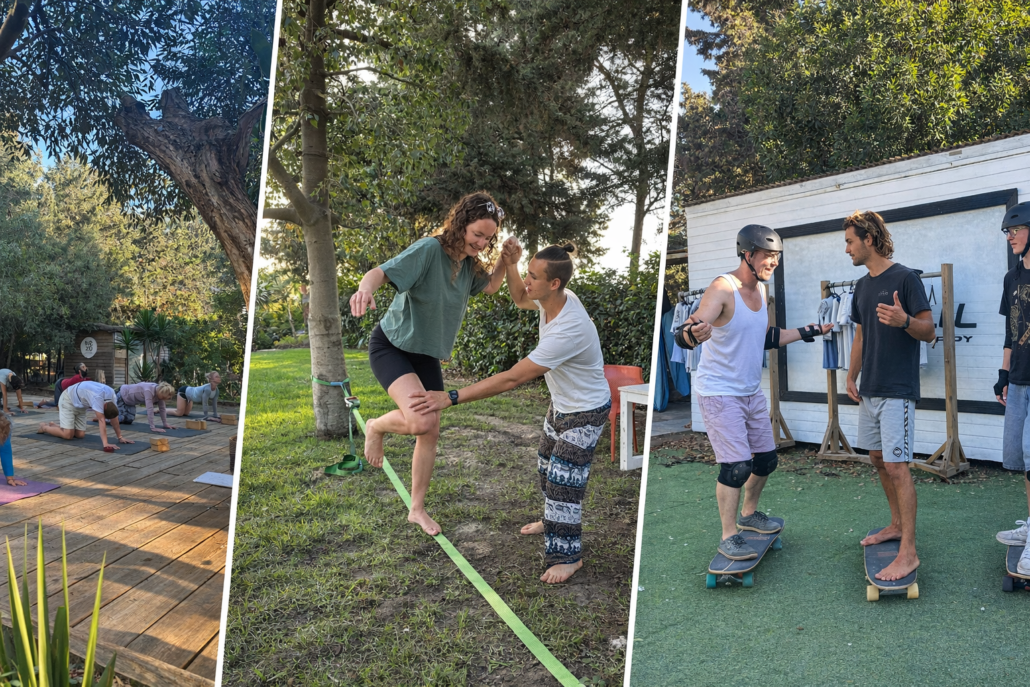
There’s also space to move outside the water, with yoga sessions to reconnect, surfskate to keep burning off energy, and calmer moments too, like a massage that leaves you feeling completely renewed.
A surf camp is not just a place to surf. It’s a place to enjoy the whole day, take care of yourself, switch off, and experience the kind of plans that, once you’ve tried them, only make you think about coming back.
In the end, all of this helps the experience go beyond the waves themselves and become about the atmosphere too, and about how you feel while you’re there.
That makes it much easier for everyone to find their place, without everything depending on being extroverted or arriving with an already-made social plan.
It’s not about adding more things just to fill the day. It’s about creating a kinder, more complete, and easier environment to settle into from the very beginning.
How the first few days usually feel
The first day can feel a little awkward. That’s completely normal.
You arrive somewhere new, see unfamiliar faces, and for a few hours it’s easy to feel a certain distance. It doesn’t mean you don’t fit in, only that you’re still settling in.
What usually happens is that contact comes naturally, without you having to force it too much.
That’s exactly why meeting people at a surf camp is often much easier than you imagined before coming.
You don’t need to be the most sociable person in the group either. A good atmosphere doesn’t force you to be “socialising” all the time. It gives you room to talk when you feel like it, and also to go at your own pace when you need a bit of space.
If that part makes you hesitate, this Lonely Planet guide on how to meet people while travelling solo can help you set your expectations without romanticising anything.
When it’s really worth it, and when maybe it isn’t
It tends to be a great fit if you feel like changing pace, having a few organised days, and not having to build the whole trip piece by piece yourself. It also works well if you like meeting people without pressure and value arriving somewhere where there is already a clear setting.
For many people, that is exactly the biggest advantage: not having to think through every single detail. You arrive, settle in, quickly understand how the day works, and allow yourself to go with the flow a little more.
On the other hand, it might not be the best format for you if you’re looking for total privacy, if shared spaces make you very uncomfortable, or if you only enjoy travelling with your usual close-knit group.
And that’s completely fine. There’s no need to sell this as if it were perfect for everyone.
Sometimes it’s just not your moment. And other times it is, but with a different type of accommodation or in a calmer setting.
If you also want to compare levels, seasons, accommodation and different types of experience, see our guide to choosing a surf camp in El Palmar
Other things worth keeping in mind
What if I want to do my own thing and not be around people all the time?
In fact, a lot of people are looking for exactly that balance. Being in a pleasant environment doesn’t mean being available all day long. What matters is that the place allows you to share when you feel like it and have space when you don’t.
Could it suit me if it’s my first time doing something like this?
Yes, absolutely. For many people, a first surf camp turns out to be much easier than they expected because they don’t have to organise everything from scratch. And if you want to get a better idea of the practical side before deciding, here you can read how to prepare for your first surf camp.
How can I tell before booking whether the atmosphere will suit me?
Look at specific things: the type of rooms, the shared spaces, the pace of the day, the activities outside the water, and the overall tone of the brand. When all of that is clear, it becomes much easier to picture yourself there and make a better decision. It also helps to check social media and articles so you can get a clearer overall impression.
When the atmosphere fits, everything changes
Going to a surf camp alone can be a very good idea when the kind of experience matches who you are. The difference usually isn’t whether you come with someone, but whether the setting, the rhythm, and the social dynamic make things feel easy for you.
If you’re looking for that kind of experience, you can take a look at our surf camp in El Palmar and see whether that format feels right for you.
And if you’d like to clear up any doubts before deciding, you can write to us here.